First date ideas in your 20s that make talking easy
The best first date isn't the most impressive one. It's the one where you can actually talk, ask follow-up questions and maybe try something neither of you has done. Here are ideas built around what the research says matters.
Jump to a section
Search for first date ideas and you get endless lists of places to go. But when researchers look at what predicts a second date, they mostly end up studying the conversation, not the venue.
So here’s a shorter list, sorted by what each idea actually makes easier.
The skill that matters most: follow-up questions
A team at Harvard studied live get-to-know-you conversations, including real speed dates. People who asked more questions were better liked, and follow-up questions, the kind that build on what the other person just said, mattered most.1 Speed daters who asked more of them were more likely to get a yes for a second date.1
The catch: people don’t expect question-asking to have this effect, so they underdo it.1
Ideas that hand you things to ask about:
- A food hall or night market, where you each pick one thing for the other to try
- A small museum or a free gallery night, ideally one neither of you knows well
- A used bookstore, where you each choose a book you think the other would like
Don’t be afraid of going a bit deeper
Small talk feels safe, but it may be the less rewarding option. In experiments by Kardas, Kumar and Epley, strangers consistently overestimated how awkward a deep conversation would be. The talks went better than predicted, and people felt more connected after deeper exchanges than shallow ones.2
Ideas that leave room to really talk:
- A long walk with a coffee or ice cream stop halfway
- A quiet bar early on a weeknight, before it gets loud
- Sitting outside somewhere with a view after a short activity
Novelty adds energy, with a caveat
Arthur Aron and colleagues found that couples who took part in novel, mildly exciting activities together reported higher relationship quality.3 Those were established couples, not first dates, so treat it as a hint rather than a rule. Still, doing something new gives two near-strangers a shared reaction to talk about.
Ideas with a little novelty:
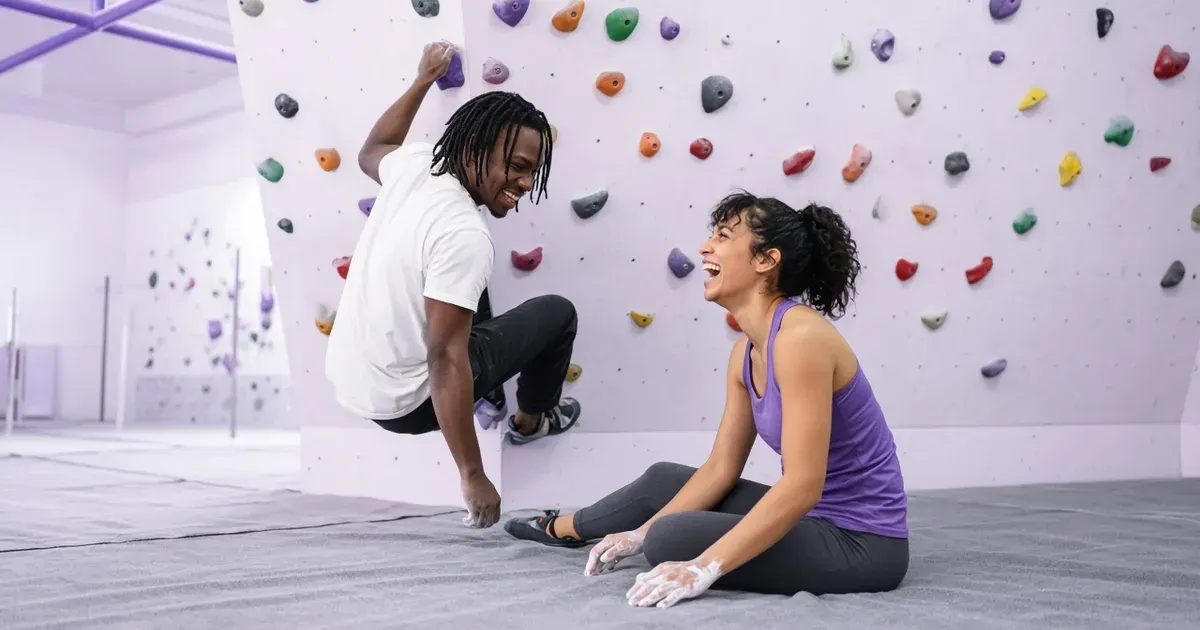
- A beginner session at a climbing or bouldering gym
- Mini golf, bowling or an arcade, if you both like a bit of competition
- A drop-in dance or improv class
Ignore the old script
A 1993 study asked young singles to describe a typical first date. Their answers followed a strong, gendered script: one person initiates, plans and pays, the other responds.4 Real dates in the study often broke from it anyway.4 That sample was small, mostly white undergraduates three decades ago, but the takeaway still holds. You can decide together who plans and how the bill gets split.
One last filter
Before you send the invite, ask: will we be able to hear each other, and is there something here to talk about? If yes, it’s a good first date idea.
After it’s over and you’re replaying every moment, our guide to reading whether it went well is there for you.
Try it
What worries you most about a first date?
People who talk about this
- Credentialed source
Alexandra H. Solomon
Relational self awareness, dating and building lasting relationships, drawn from her couples work and her Northwestern course.
- Credentialed source
Justin J. Lehmiller
Research on sex, desire, casual relationships and friends with benefits.
- Credentialed source
- Trending voice
Nedra Glover Tawwab
Boundaries in relationships, family and friendship, and how to say what you need.
- Credentialed source
- Trending voice
Ramani Durvasula
Narcissistic and high conflict relationships, and recovering after leaving one.
Further reading
Pew Research Center, 2023
The who, where and why of online dating in the U.S. (opens pewresearch.org)Survey numbers on who uses dating apps, which ones, and why, with a close look at adults under 30.